
Tangram Heaven
Gimica GmbHPuzzle
4.2437.00 Reviews
- Version
- 1.8.0
- Installs
- 1.00M
- Age Rating
- Everyone
Screenshots
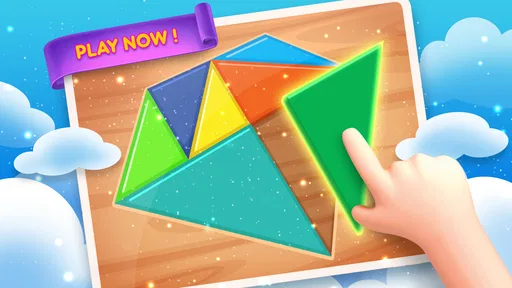
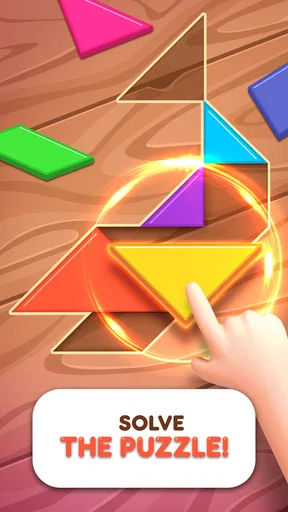
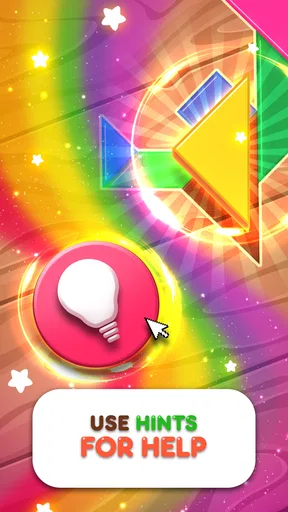
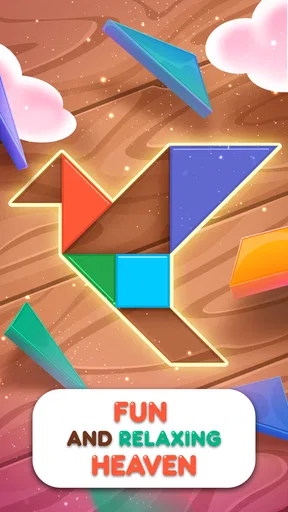
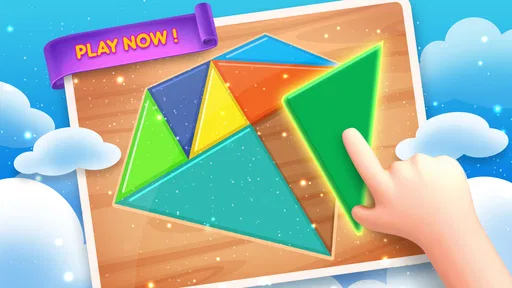
Our Review of Tangram Heaven
 Analysis by Appyee
I like puzzle games that are easy to understand but still leave room for better decisions, and Tangram Heaven fits that description well. It is a free puzzle game from Gimica GmbH built around arranging geometric pieces into a target shape. The idea is familiar, but the appeal comes from the quiet concentration required: you can see the pieces, you can see the outline, and the challenge is working out how they belong together without rushing.
That makes it a comfortable choice for short breaks, relaxed evening play, or anyone who enjoys visual problem-solving more than fast reactions. I found the experience most satisfying when I treated each board as a small exercise in planning rather than simply trying random placements. The game’s store summary calls it “Puzzle Heaven in Your Pocket,” while its short description presents it as “Tangram Heaven”; in practice, I would describe it as a straightforward tangram-style game with a calm, accessible rhythm.
It is listed as a puzzle game for Everyone, so the basic concept is suitable for a broad audience. The game has reached over a million installs and holds a 4.2 average from around 3,200 ratings, which suggests that its simple format has found a sizeable audience. I would not choose it for competitive intensity or a story-driven experience, but I would recommend it to someone who wants a focused game that can be picked up without learning a complicated rule set.
How the everyday puzzle loop works
The best way to approach a board is to begin with the outline rather than the loose pieces. I first look for corners, narrow points, and unusually long edges in the target. Those areas usually give me more information than the broad middle, where several pieces may appear to fit. Once a distinctive piece has a likely home, the remaining space becomes easier to read.
This is more useful than dragging pieces around at random. A random approach can work on an easy board, but it becomes frustrating when several shapes seem interchangeable. I prefer to separate pieces mentally into groups: large shapes, thin shapes, pieces with sharp angles, and pieces that could plausibly form an outside edge. That small habit reduces unnecessary movement and makes mistakes easier to diagnose.
There is also a useful difference between a piece that looks correct and one that actually belongs. A piece may cover much of an area while leaving a tiny gap along one side. I learned to inspect the complete boundary after every placement instead of judging by the largest filled section. This is especially important with similar triangles, because a nearly correct position can look convincing until another piece has nowhere sensible to go.
For a normal play session, I would start with the most constrained part of the design, place one or two confident pieces, and then reassess the empty spaces. If the next move feels uncertain, I do not force it. I return to the pieces with distinctive angles and test the outline again. This creates a repeatable workflow that feels more thoughtful than trial and error without turning a casual game into a formal solving exercise.
A realistic use case is a short commute or a waiting room. I can open a board, make progress for a few minutes, and stop without needing to remember a complicated plot or a long chain of objectives. It also works well as a screen break between demanding tasks because the attention it requires is narrow and concrete. I would be less likely to use it when I want something energetic, social, or deeply absorbing for a long uninterrupted session.
What I check before making a difficult move
When I reach a stubborn board, I check three things before moving anything else. First, I look at the negative space: the empty area often reveals the required shape more clearly than the pieces themselves. Second, I compare angles rather than overall size. Two pieces can occupy a similar amount of space but have completely different corner behavior. Third, I consider what the placement will leave behind. A move is stronger when it creates a clean, recognizable gap for another piece.
This last point is easy to overlook. Solving a tangram is not only about finding where a piece fits now; it is about preserving useful spaces for later. A placement that fills a large region may still be poor if it divides the remaining area into awkward slivers. I get better results by asking whether the move simplifies the next decision.
I also avoid constantly changing several pieces at once. If I move three pieces and the board becomes worse, I no longer know which assumption caused the problem. Testing one uncertain placement at a time makes the game feel more controlled. It is a small discipline, but it helps when the visual similarities between pieces start to blur.
Settings and comfort choices worth checking
Because this is a compact puzzle game, the most important settings are the ones that affect how comfortably I can see and manipulate the board. Before settling into regular play, I check the available game options rather than assuming the default setup will suit every session. A quiet puzzle can become tiring if the visual presentation or interaction feels distracting on a smaller screen.
I also pay attention to how I hold the device. Playing one-handed is convenient, but it can make precise placement less comfortable, especially when a piece needs to be moved across a broad board. Holding the phone with both hands gives me better control and reduces accidental movement. On a tablet, the larger display can make the overall shape easier to inspect, although the extra space does not remove the need to compare angles carefully.
Another practical habit is to play with a clean screen and a stable grip. That sounds obvious, but tangram puzzles depend on recognizing narrow gaps and exact corners. Finger marks, glare, or an awkward position can make a correct piece appear wrong. I prefer to solve harder boards when I am not walking or multitasking, because visual accuracy matters more here than speed.
The game is free to download, with in-app purchases ranging from $0.99 to $3.49 per item. That makes it easy to try without committing money first, but I would still check the purchase flow carefully if a child uses the device. The Everyone rating describes the intended age suitability, not a reason to ignore normal device safeguards. For my own use, the free entry point is the main advantage; I can decide whether the core puzzle loop suits me before considering any optional spending.
The current version is 1.8.0 and it runs on Android 7.0 or later. That broad operating-system requirement is helpful for people using older compatible Android devices. I would still keep the game updated through the normal app store process, since updates can affect stability and presentation even when the central puzzle idea remains unchanged.
Faster solving without losing the calm
Experienced play is less about moving quickly and more about reducing wasted decisions. My fastest reliable pattern is to identify the outside boundary first. Long straight edges and sharp outer corners usually provide stronger evidence than pieces intended for the center. Once the frame begins to take shape, interior pieces have fewer plausible positions.
I then look for complementary spaces. If the empty area resembles a narrow triangle, I search for a piece that can fill it without disturbing the outer line. This reverses the usual instinct to inspect pieces one by one. Sometimes the gap tells me what I need more clearly than any loose piece does.
Symmetry can help, but I treat it as a clue rather than a rule. A visually balanced target may tempt me to mirror a placement, yet tangram pieces can create similar-looking arrangements with different boundaries. I use symmetry to generate a possibility, then verify it against the exact corners and remaining gaps. That prevents a pleasing but incorrect arrangement from controlling the rest of the board.
Another useful routine is to keep a mental record of rejected positions. If a piece fails because it leaves an impossible sliver, I do not immediately test the same orientation somewhere else without thinking. I remember what kind of space it needs and compare that requirement with the board. This turns failed moves into information instead of repeated frustration.
I would not describe the game as a speed challenge, and I do not think rushing improves it. The satisfaction comes from seeing the structure emerge. If I try to optimize every move, I lose some of the relaxing quality that made me choose this type of game. My preferred balance is to use efficient habits while still allowing myself time to inspect the design.
Where the simple format reaches its limits
Tangram Heaven’s focused concept is also its main limitation. Players who want a campaign with characters, a strong narrative, multiplayer competition, or a constantly changing set of mechanics may find the experience too narrow. The game is built around visual arrangement, so its appeal depends heavily on whether that activity itself remains enjoyable for you.
It can also become less satisfying if you dislike puzzles that require patience rather than deduction from explicit clues. The board gives visual information, but the player still has to interpret it. When several pieces appear possible, progress may depend on careful comparison and occasional backtracking. I see that as part of the genre, but someone looking for immediate, obvious feedback might prefer a match-three game or a word puzzle with clearer short-term rewards.
There is a difference between difficulty and friction here. A challenging shape can be rewarding because it teaches me to read space more accurately. Repeating uncertain placements, however, can feel like friction if I have not formed a plan. I get the best experience when I pause after a failed attempt and identify why it failed. Without that reflection, the game can turn into repetitive dragging.
It is also not the ideal choice for every setting. On a moving vehicle, fine placement may be harder than expected. In a noisy environment, the calm visual focus can be interrupted. If I have only a few seconds, a board may not provide the instant payoff of a very short arcade round. This is a game for deliberate minutes, even when those minutes are few.
The purchase range is another consideration. The game is free, but optional items can cost between $0.99 and $3.49 each. I would not treat spending as necessary to understand the basic appeal, and I would make sure any purchase is intentional rather than the result of tapping through a prompt quickly. Players who want a completely purchase-free experience should take that structure into account before making it a regular game for a family device.
Small habits that make harder boards clearer
One of my most useful habits is to solve from constraint to flexibility. A corner with a single likely angle deserves attention before a wide central region that could accept several pieces. This approach narrows the possibilities naturally. It also helps me avoid spending too much time on pieces that look attractive simply because they are large.
I sometimes use a temporary “anchor” piece: a placement that is not necessarily the final answer but gives me a stable reference for judging the rest of the board. I only keep it if the surrounding gaps remain plausible. If it creates awkward fragments, I remove it quickly. The value of an anchor is not that it is guaranteed correct; it is that it helps reveal whether the board’s geometry is becoming more coherent.
Another advanced but simple technique is to compare the angles left by a placement, not just the amount of space filled. A broad empty area can hide a sharp corner that only one remaining piece can satisfy. When I notice that corner early, I can protect it instead of accidentally blocking it with a convenient-looking piece.
I also recommend taking a brief visual reset after several failed attempts. I move my attention away from the board for a moment, then return by looking at the target as a whole. This prevents me from becoming attached to an incorrect arrangement. In a puzzle based on similar shapes, a fresh glance can be more useful than another minute of increasingly narrow focus.
These habits do not turn the game into a technical simulation, and they are not secret mechanics. They are simply ways of reading the board more effectively. That distinction matters: the game remains approachable, but it rewards players who develop a consistent method instead of relying entirely on luck.
My verdict after settling into the routine
Tangram Heaven is a good fit for anyone who wants a focused, low-pressure puzzle game that can fill a short break without demanding a large time commitment. I appreciate that the central activity is immediately understandable, yet careful players can still improve through better observation, boundary planning, and control of the remaining space. The free starting point makes it easy to test that loop for yourself, while the Everyone rating keeps the concept broadly approachable.
My recommendation is strongest for fans of visual puzzles, tangram fans, and people who enjoy quiet concentration. It is also useful for someone who wants a game that does not depend on reflexes or a complicated learning curve. I would suggest playing with a stable grip, checking the available comfort settings, beginning with distinctive corners and edges, and treating failed placements as clues rather than wasted attempts.
I would skip it if your priority is a rich story, competitive play, constant novelty, or rapid action. I would also choose a different puzzle category when I want word-based reasoning, timed pressure, or an immediately rewarding chain of matches. This game’s strength is narrower and more specific: it gives me a clean visual problem and lets me work through it at my own pace.
For me, the best way to enjoy it is to combine the simple baseline workflow with a few repeatable habits: inspect the outline, protect constrained gaps, test one uncertain move at a time, and reset my view when I get stuck. That is enough to make the experience feel more satisfying than casual piece dragging. If you enjoy turning a messy group of shapes into one complete design, this is a pleasant pocket puzzle worth trying.
Gimica GmbH has kept the concept easy to approach, and the version 1.8.0 release sits on a platform range that includes Android 7.0 and later. With over a million installs, it is clearly not an obscure experiment, but popularity alone is not the reason I would recommend it. I recommend it because the game understands its own scale: it offers a compact visual challenge, works well in ordinary spare moments, and becomes more enjoyable when you learn to see the empty spaces as carefully as the pieces.
Verdict
Strengths of Tangram Heaven
- Relaxing puzzle gameplay suitable for short or extended sessions.
- Simple drag-and-drop controls are easy for players of all ages.
- Colorful geometric pieces make completed designs satisfying to view.
- Gradually increasing challenges provide a gentle learning curve.
- Offline play makes it convenient for travel or areas with limited internet.
Limitations of Tangram Heaven
- Some levels may feel repetitive after extended play sessions.
- Hints or extra assistance may be limited in difficult puzzles.
- The game can become less challenging for experienced puzzle players.
- Ads may interrupt gameplay, depending on the app version.
- Small pieces can be harder to position accurately on smaller screens.
Other Releases by Gimica GmbH
View All


Similar Picks in This Category
View All
Block Blast!
HungryStudio4.8

Braindom: Brain Games Test
Lahana Game Studio4.6

AMAZE!
CrazyLabs LTD4.6

Sudoku - Classic Sudoku Puzzle
Oakever Games4.7

Art Puzzle - Puzzle Games
Easybrain4.8

Amaze GO!
Oakever Games4.9
Frequently Asked Questions
What is Tangram Heaven, and how does the game work?
Tangram Heaven is a relaxing puzzle game based on the classic tangram concept. You arrange geometric pieces on a board to recreate silhouettes, objects, animals, and other shapes. The game is generally easy to understand, but later puzzles can require careful planning, rotation, and spatial reasoning. It is designed for short sessions as well as longer, more focused play.
Is Tangram Heaven suitable for children and beginners?
Yes, Tangram Heaven is approachable for beginners because its core mechanics are simple and usually introduced without a steep learning curve. Children can also enjoy it as a visual and logic-based activity, although younger players may need help with more difficult levels. Parents should still review the app’s age rating, advertisements, and any in-app purchase options before allowing unsupervised use.
Does Tangram Heaven work without an internet connection?
Many tangram puzzles can typically be played offline once the game has been installed, making Tangram Heaven convenient for travel, waiting rooms, or areas with limited connectivity. However, certain features may depend on an internet connection, including advertisements, cloud synchronization, updates, leaderboards, or promotional content. It is best to test the game offline after installation rather than assuming every feature will be available.
Are there hints, timers, or other features that affect the difficulty?
Tangram Heaven may include helpful tools such as hints, level progression, visual guidance, or optional challenges, depending on the version available on your device. These features can make difficult puzzles more accessible, while players who prefer a greater challenge can often solve boards without assistance. Check the in-game menus carefully, because hints may be limited, rewarded through gameplay, or connected to advertisements or purchases.
Is Tangram Heaven free to download, and does it contain ads or purchases?
Tangram Heaven may be available as a free download, but the exact monetization model can vary between Android and iOS versions and may change with updates. Free versions commonly support the experience with advertisements, while optional purchases may remove ads, unlock additional puzzles, or provide hints. Before downloading, review the store listing and purchase settings so you understand what is included at no cost.
Play our best games!


